

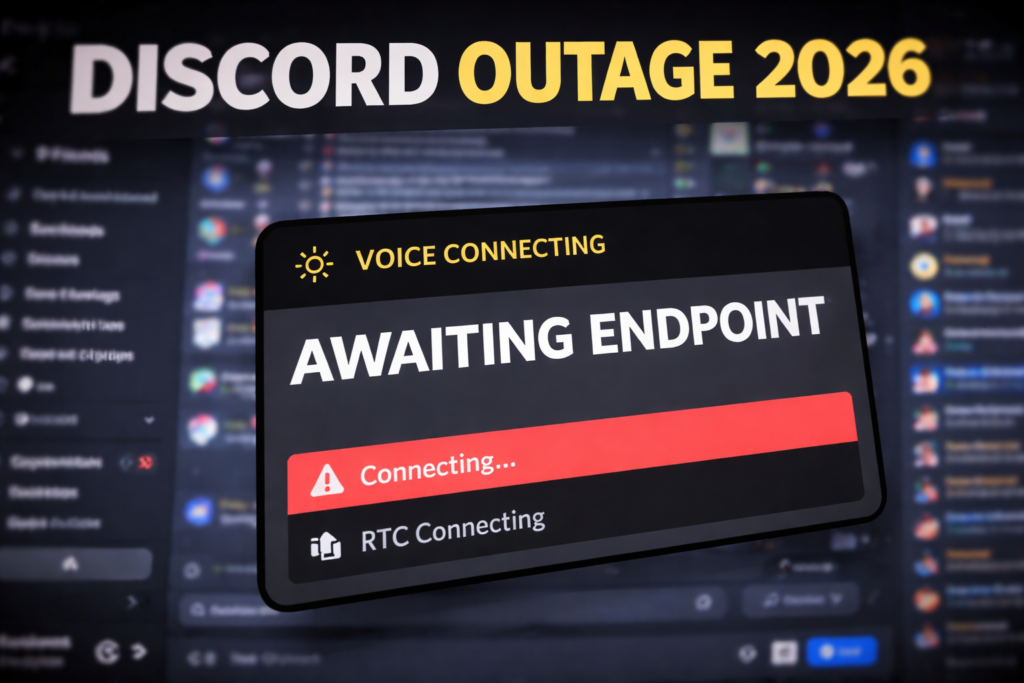
On March 25–26, 2026, users of the popular communication platform Discord experienced a major service disruption that left tens of thousands unable to connect, particularly affecting voice calls, messaging, and server access. Across social media and outage tracking services, reports spiked with complaints of the infamous “Awaiting Endpoint” error — a message that appears when Discord’s client cannot connect to voice servers.
Discord’s official status page acknowledged the incident, confirming that engineers were investigating issues preventing users from connecting and that efforts were underway to restore voice traffic.
The scale of this outage — similar to previous disruptions the platform has faced — highlights both Discord’s critical role in online communication and the challenges of maintaining such a widely used service.
Discord Outage 2026: Timeline of Events
Initial Reports and Outage Detection
Problems began to emerge around midday (UTC‑0700) on March 25, 2026, when users worldwide started reporting connectivity issues across voice, text, and group calls. Within minutes, user reports surged on crowd‑sourced outage tracker sites like Downdetector, which aggregates hundreds of thousands of real‑time submissions.
Thousands of people saw the error “Awaiting Endpoint” when trying to join voice chats, especially during the peak of the disruption when reports exceeded 20,000. More than 75% of user complaints were tied to voice call failures, while others reported login or general app issues.
Official Acknowledgement and Updates
Discord’s status update posted on their official tracking page showed that engineers had identified the root cause and were actively attempting to restore voice traffic. However, some residual issues remained, particularly affecting the platform’s API and certain messaging features.
Simultaneously, Discord communicated with users on social media platforms like X (formerly Twitter), reassuring them that team members were working on mitigation — a typical response in major outages for real‑time applications.
What Users Experienced During the Discord Outage 2026
Voice Chat Failures and “Awaiting Endpoint” Errors
The overwhelming majority of reports during the outage focused on voice call failures. Users attempting to join voice channels or start direct calls were frequently met with the “Awaiting Endpoint” message — a sign the client could not establish a connection to a voice server.
This error is typically associated with backend infrastructure problems rather than local device issues, and it has historically been a central symptom in previous Discord outages as well.
Some users reported intermittent connectivity, where certain channels might work briefly before failing again, suggesting the problem was fluctuating rather than a complete shutdown.
Messaging and Login Problems
Although less widespread than voice issues, a smaller subset of users also reported difficulties sending messages, loading channels, or logging into the app. These secondary issues are consistent with broader server disruptions, where multiple components of the platform are affected simultaneously.
Why the Discord Outage 2026 Happened
Technical and Infrastructure Challenges
Discord, like many large platforms, operates a distributed infrastructure of servers that support different functions, including text messaging, voice, video, and API services. When one of these components malfunctions — particularly the voice or gateway services — the result can appear as major outages for users.
In the case of the Discord Outage 2026, Discord engineers quickly identified the cause and initiated fixes to restore voice connectivity, pointing to disruptions in internal communication systems rather than widespread global internet failures.
Historical Outages Suggest Similar Patterns
Previous outages — including a notable one in August 2025 where millions encountered the “Awaiting Endpoint” error — were traced back to infrastructural load and server routing issues that prevented stable connections to voice services.
Another widespread incident in mid‑2025 was partially tied to an external cloud provider’s outage, demonstrating how dependencies on third‑party infrastructure (like cloud hosting) can ripple into Discord’s operations.
While Discord has not publicly released a full technical report for the 2026 outage, these historical patterns suggest that server load spikes, backend routing failures, or internal API issues are among the most common culprits.
How the Discord Outage 2026 Affected Users
Impact on Gaming and Communities
Discord is a crucial tool for millions of people — from gamers coordinating strategies to communities hosting events, study groups, remote teams, and content creators. A voice and connectivity outage disrupts real‑time coordination, communication, and even social interaction.
Users on message boards shared stories of sudden dropouts during gaming sessions, failed calls with friends, and inability to access crucial group chat functionality.
Business and Remote Communication Interruptions
Beyond entertainment, many remote work teams and professional groups use Discord’s voice and video features. An outage can therefore have consequences beyond casual chatting — including missed meetings, disrupted workflows, and urgent communication breakdowns.
How to Check Discord Service Status
If you’re unsure whether Discord is truly down or experiencing localized problems, these tools can help:
- Discord’s Official Status Page: Provides real‑time updates on current incidents and component health.
🔗 DoFollow: https://discordstatus.com/ - Downdetector: Tracks user‑reported outage data from multiple regions.
🔗 DoFollow: https://downdetector.com/status/discord/ - Reddit Community: Threads often collect user reports and official status updates.
🔗 DoFollow: https://www.reddit.com/r/discordapp/
These external resources give real‑time insight into whether issues are widespread or localized.
Troubleshooting Tips During a Discord Outage
Even during an outage, there are steps users can take to determine whether the problem is on Discord’s side or their own:
1. Verify Your Internet and Connection
- Test your Wi‑Fi or Ethernet connection.
- Try opening Discord in a web browser vs. the desktop app to isolate client‑specific issues.
- Disable VPNs and proxies that can interfere with connectivity — these can affect voice negotiation.
2. Restart the App and Clear Cache
Sometimes local cache corruption or client bugs cause connection failures — especially if services are unstable server‑side.
3. Check Firewall or Security Software
Firewalls or firewalls on your network may block Discord’s UDP ports critical for voice — especially on restricted or public networks.
4. Wait for Official Resolution
If external trackers and Discord’s status page confirm a broad outage, the best course is to wait for engineers to roll out fixes — updates are often communicated via the status page and Discord support channels.
For more detailed checks on whether Discord is down or if the problem might be localized, guide pages such as this complete status and fixes guide offer a step‑by‑step approach:
🔗 DoFollow: https://apistatuscheck.com/blog/is-discord-down-guide
Conclusion: Discord Outage 2026 and What It Means
The Discord Outage 2026 underscores the challenges of maintaining real‑time communication platforms at global scale. With tens of thousands impacted — especially around voice connectivity — users saw firsthand how even well‑established services can fail under certain conditions.
Thankfully, Discord acknowledged the issue, identified the cause quickly, and implemented fixes to restore service. Users should continue monitoring the official Discord status page and trusted outage trackers for the most accurate updates.
Whether you’re a gamer, a community leader, or someone who uses Discord for remote communication, this outage serves as a reminder to plan for alternative communication methods when critical platforms face disruptions.

Leave a Reply