

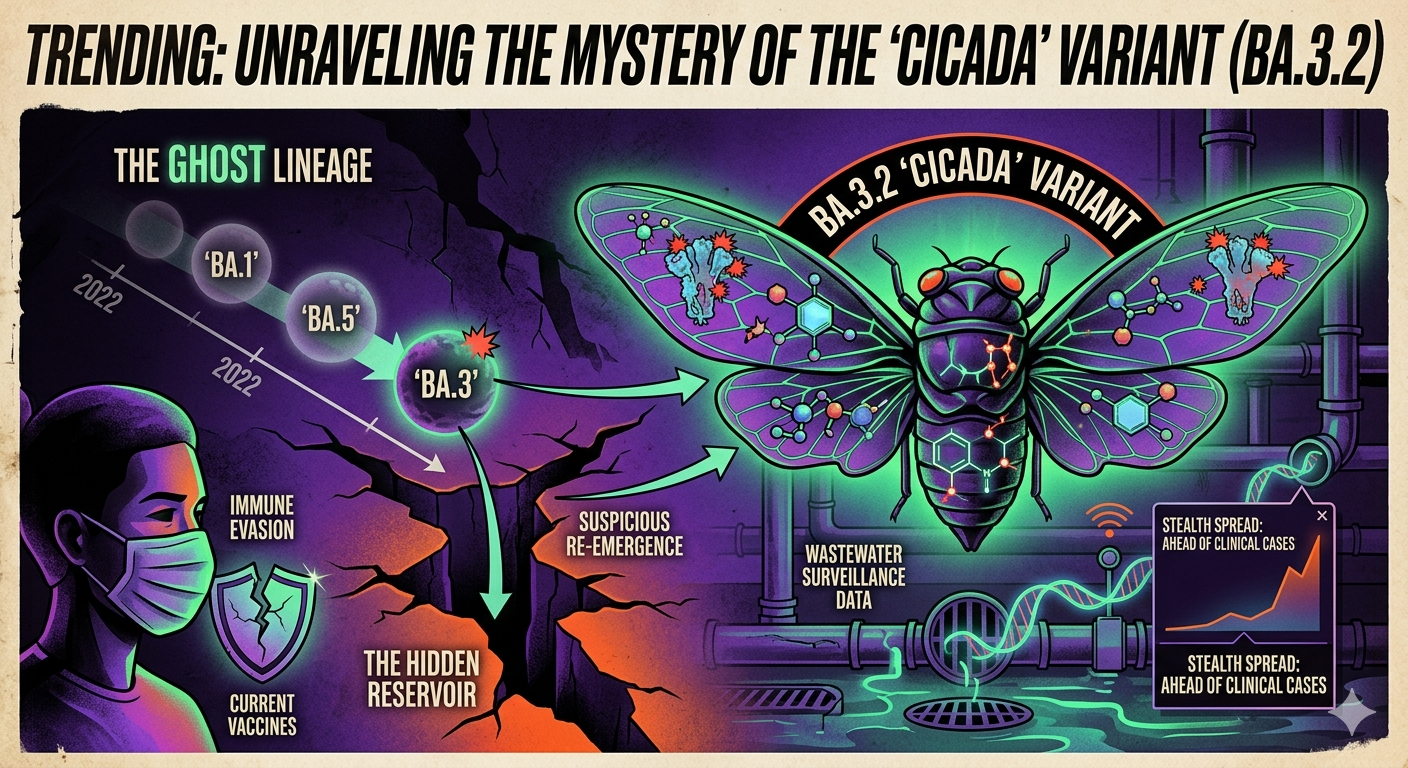
A new name is dominating global health headlines: BA.3.2. Nicknamed the “Cicada” variant, this strain has triggered a wave of “suspicious” news reports due to its bizarre origin story and its ability to spread undetected for months.
As of March 26, 2026, the CDC and WHO are tracking its rapid rise in 23 countries, including a significant presence in U.S. wastewater. Here is everything you need to know about the “Undead” variant.
1. Why the Nickname “Cicada”?
In biology, cicadas spend years underground before suddenly emerging in massive swarms. BA.3.2 earned this nickname because it is a direct descendant of BA.3—a lineage that scientists believed had gone extinct in early 2022.
After nearly four years of silence, this “ghost lineage” has re-emerged with over 75 new mutations, leading experts to believe it may have been evolving in a “hidden reservoir,” such as a chronic infection in an immunocompromised patient or an animal population.
2. The Trending Numbers: Where is BA.3.2 Now?
While clinical cases remain low (under 1% of total sequences), wastewater surveillance tells a different story.
- U.S. Spread: Detected in 29 states and Puerto Rico.
- European Surges: Accounts for nearly 30% of cases in Denmark, Germany, and the Netherlands.
- Stealth Growth: In many regions, the variant appeared in sewage weeks before a single patient tested positive in a clinic.
3. Scientific Red Flags: 75+ Mutations
What makes BA.3.2 “suspicious” to genomic researchers is the sheer volume of genetic changes.
- Immune Escape: With 70–75 mutations on the spike protein, BA.3.2 is genetically further from the current JN.1-based vaccines than any previous variant.
- Lab Findings: Early data from the University of Tokyo and Johns Hopkins suggest that while it is excellent at evading antibodies, it may have a harder time entering lung cells, which could explain why it hasn’t caused a massive spike in hospitalizations—yet.
4. Symptoms to Watch For in 2026
Patients infected with the Cicada variant frequently report a specific set of “trending” symptoms:
- “Razor Blade” Sore Throat: A hallmark of the 2026 wave.
- Profound Fatigue: Exhaustion that lasts significantly longer than earlier Omicron strains.
- Low-Grade Fever & Body Aches: Less respiratory distress, more systemic inflammation.
- Stealth Infection: Many carriers report no symptoms at all, aiding its “cicada-like” quiet spread.
5. Is the Current Vaccine Effective?
Health officials at the CDC (External Link: cdc.gov/mmwr) state that while the 2025-2026 boosters offer “reduced” protection against infection from BA.3.2, they remain highly effective at preventing severe disease and death.

Leave a Reply