
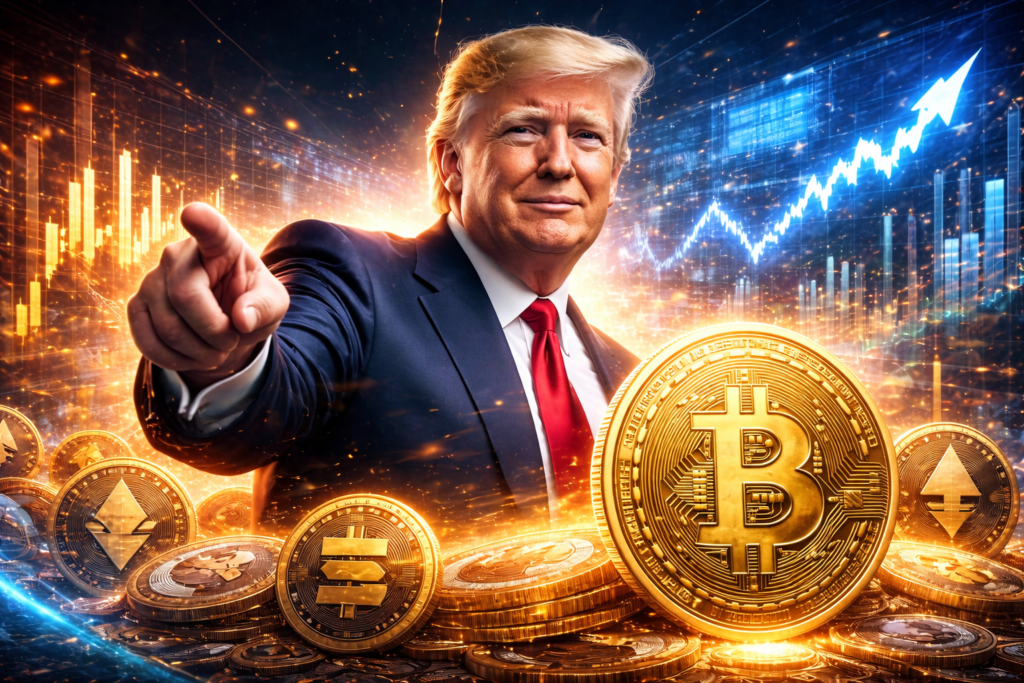
Cryptocurrency at a Political Crossroads
Cryptocurrency has evolved from a niche technological experiment into a major pillar of global finance. With trillions of dollars in market activity and increasing institutional adoption, digital assets now sit at the intersection of innovation, regulation, and geopolitics. As political leadership shapes financial policy, the stance of key figures like Donald Trump becomes increasingly important.
Trump’s earlier skepticism toward cryptocurrencies—combined with a broader “America First” economic philosophy—suggests a complex future. His approach is likely to balance innovation with national security concerns, focusing on protecting the U.S. dollar while navigating the rise of decentralized finance.
1. Trump’s Past Views on Cryptocurrency
Trump has historically expressed caution toward cryptocurrencies. During his presidency, he indicated that he was not a fan of digital currencies, emphasizing concerns about volatility, lack of regulation, and potential misuse.
Key concerns included:
- Threats to the dominance of the U.S. dollar
- Use of crypto in illicit activities
- Lack of centralized control
However, his position has evolved alongside broader market changes. The growing legitimacy of digital assets has made it difficult for policymakers to ignore the sector.
2. Cryptocurrency vs U.S. Dollar: Strategic Competition
One of the central themes in any future Trump crypto policy is likely to be the protection of the U.S. dollar as the world’s primary reserve currency.
Cryptocurrencies—especially decentralized ones like Bitcoin—challenge traditional monetary systems. They operate outside central bank control, making them attractive but also disruptive.
A Trump-led strategy may include:
- Strengthening the dollar’s global dominance
- Regulating crypto to prevent financial instability
- Encouraging innovation without undermining national currency
3. Regulation vs Innovation: Finding the Balance
The future of cryptocurrency in the United States will depend heavily on regulatory clarity. Trump’s approach may focus on reducing regulatory uncertainty while maintaining oversight.
Potential policy directions:
- Simplified regulations for crypto businesses
- Stronger compliance rules for exchanges
- Clear tax frameworks for digital assets
Rather than banning cryptocurrencies, the likely approach would be structured regulation to integrate crypto into the financial system.
4. Central Bank Digital Currency (CBDC) Debate
A major policy question is whether the United States should develop a digital dollar, also known as a Central Bank Digital Currency (CBDC).
Trump has shown skepticism toward centralized digital currencies, primarily due to concerns about:
- Government overreach
- Financial surveillance
- Privacy risks
This suggests that under his influence, the U.S. might delay or limit CBDC development while supporting private-sector innovation.
5. National Security and Crypto Oversight
Cryptocurrency’s decentralized nature presents challenges for law enforcement and national security agencies.
Trump’s strategy is likely to emphasize:
- Monitoring cross-border crypto transactions
- Preventing illicit financing
- Strengthening anti-money laundering (AML) rules
Agencies such as U.S. Securities and Exchange Commission and Financial Crimes Enforcement Network would play key roles in enforcement.
6. Cryptocurrency and Global Competition
The rise of digital currencies is not limited to the United States. Countries like China are actively developing state-backed digital currencies.
Trump’s geopolitical strategy may include:
- Countering China’s digital yuan
- Promoting U.S.-based crypto innovation
- Ensuring American leadership in blockchain technology
This transforms cryptocurrency from a financial issue into a strategic global competition.
7. Impact on Investors and Businesses
Trump’s policies could significantly impact crypto investors, startups, and institutional players.
For Investors:
- Greater regulatory clarity may reduce risk
- Market volatility may continue due to policy shifts
For Businesses:
- Easier compliance frameworks could encourage growth
- U.S.-based crypto companies may benefit from pro-business policies
For Financial Institutions:
- Integration of crypto into traditional finance may accelerate
8. The Future of Cryptocurrency Under Trump
Looking ahead, the future of cryptocurrency under Trump would likely be defined by a hybrid approach:
Supportive Elements:
- Encouraging blockchain innovation
- Promoting U.S. technological leadership
Restrictive Elements:
- Tight oversight on transactions
- Strong enforcement against misuse
This dual strategy reflects a broader trend: governments increasingly accept crypto but seek to control its risks.
Global Implications of U.S. Crypto Policy
The United States plays a central role in global finance. Any policy shift under Trump would have ripple effects worldwide.
Key global impacts include:
- Influence on international crypto regulation
- Changes in capital flows and investment patterns
- Competitive responses from other major economies
As a result, U.S. crypto policy is not just domestic—it shapes the global financial system.
Challenges Ahead
Despite growing adoption, several challenges remain:
- Regulatory uncertainty
- Market volatility
- Security risks (hacks, fraud)
- Balancing innovation with control
Addressing these challenges will require coordinated efforts between government agencies, private companies, and international partners.
Conclusion: A Defining Moment for Crypto Policy
Cryptocurrency is entering a critical phase where political leadership will determine its trajectory. Under Donald Trump, policy is likely to reflect a balance between economic nationalism and technological adaptation.
While Trump may not fully embrace decentralized finance, he is unlikely to ignore its growing importance. Instead, his approach could shape a regulated but thriving crypto ecosystem in the United States.
Ultimately, the future of cryptocurrency will depend on how effectively policymakers manage the tension between innovation and control—making this one of the most important financial debates of the decade.



Leave a Reply